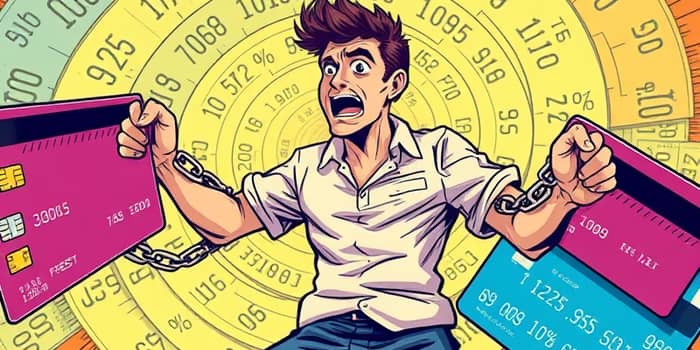
In today’s economy, an increasing number of consumers find themselves relying on the minimum required payment each billing cycle. While this approach can offer temporary relief, it often snowballs into years or decades of debt. This article examines the prevalence, true costs, market trends, and actionable strategies to escape this fiscal trap.
By delving into the data and industry context, we reveal how making only the minimum payment can become a chronic minimum payment habit, sapping resources and inhibiting financial growth. With clear insights and practical guidance, you can shift toward potential savings and debt reduction and reclaim control.
Recent figures underscore how widespread the habit has become. In 2024, 15% of general-purpose cardholders and 20% of private-label cardholders made only the minimum payment at least once—the highest levels since 2015. By 2025, 22% of all credit card users reported making minimum payments exclusively on their balances.
Although many consumers use minimum payments as a short-term liquidity cushion, repeated reliance can indicate deeper financial stress. Chronic use often goes unnoticed until high interest charges accumulate.
The key risk of paying only the minimum lies in how most of that payment covers interest rather than principal. With average APRs approaching 21–23%, balances can linger for decades.
For example, a $6,730 balance at a 22% APR making only 2–4% minimum payments could take upwards of 20–30 years to pay off, costing thousands in additional interest. In contrast, the 43% of consumers who paid in full avoided these escalating interest costs trapping their finances.
Total credit card balances reached $1.16 trillion in 2025 and are projected to grow to $1.18 trillion by end-2026. Purchase volume rose to $3.6 trillion in 2024, up from $3.2 trillion in 2022. Meanwhile, delinquency rates hovered at 3.6% in Q4 2024, with 90+ days past due projected at 2.57% by late 2026.
Industry responses—such as raising minimum floors to $40—have improved principal paydown slightly, but a significant share of balances still remains on autopilot minimums.
Economic projections forecast modest balance growth of 2.3% annually, the smallest since 2013 excluding stimulus years. However, rising household debt and potential unemployment increases could push more consumers toward minimum payments.
At the same time, inflation near 2.45% and expected Federal Reserve rate cuts may ease borrowing costs. But without deliberate payoff strategies, many will remain caught in a cycle of high-interest repayments.
Small businesses also feel the strain: average credit card debt for cash flow reached $700, underscoring that minimum payments are not solely a consumer issue.
Escaping the minimum payment trap requires deliberate action and disciplined planning. Adopting a few key tactics can yield potential savings and debt reduction and restore confidence.
By committing to strategic budgeting and full repayment, you can significantly shorten payoff timelines and slashing overall interest paid.
Credit card minimum payments provide a short-term solution but carry long-term consequences. With over $1.16 trillion in balances and high APRs, the practice can imperil long-term financial health and stability.
Empower yourself by reviewing your statements, understanding your APRs, and setting clear goals to move beyond the minimum. Small shifts in payment habits today can yield remarkable improvements in your financial future.
References