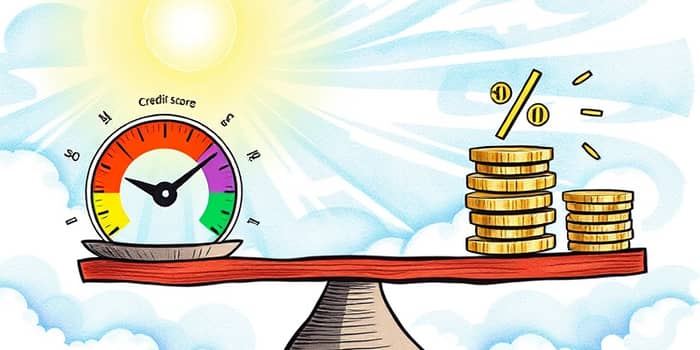
Every personal loan application carries an invisible die roll: lenders assess risk to set your rate. Your credit score is the weight in that roll, influencing whether you pay a few percent or unforgiving double digits.
In this guide, you will discover how credit scores translate into interest rates, learn strategies to strengthen your profile before applying, and gain practical steps to save thousands over your loan term.
Lenders rely on credit scores as a standardized risk measurement tool, condensing years of payment history into a three-digit number. A high score signals reliability, while a low score prompts caution.
When you apply for an unsecured personal loan, banks and credit unions analyze that score alongside income, debts, and length of credit history. Together, they determine whether you qualify—and at what price.
Mindful borrowers recognize that every point change in score can shift interest by fractions or even whole percentage points, directly affecting monthly payments and overall cost.
Credit scores generally fall into five categories, each tied to distinct rate brackets. Below is a snapshot of how those numbers correspond to average APRs:
This table illustrates why improving your score matters. A shift from fair to good, for instance, can lower rates by several points, saving thousands over a multi-year loan.
Imagine two borrowers each take a $10,000, five-year personal loan. The first has a 750 score and secures a 6.99% APR, while the second has a 570 score and faces 35.99%.
In the excellent score scenario, monthly payments are about $198, totaling roughly $11,878 over five years. The low score scenario demands $361 per month, totaling $21,676. That’s a difference of nearly $10,000 in interest alone.
Such disparities underscore why even a modest score increase can translate into major financial relief—and why strategic improvements pay off before signing any loan agreement.
Credit score is king, but five additional variables influence your personal loan cost:
Credit unions are member-owned, not-for-profit institutions. That structure allows them to offer lower rates and fewer fees than many banks. Members benefit from community focus and personalized service.
Longer terms—often up to seven years—paired with competitive APRs can make credit unions especially attractive for borrowers seeking predictability and peace of mind.
You don’t need to wait years to see improvement. Concrete actions can raise your score in as little as one billing cycle:
Applying triggers a hard inquiry, which may temporarily dip your score by a few points. When the loan posts, the new account reduces your average account age.
However, regular timely payments boost your payment history and can lower credit utilization—both vital to your long-term score. Over time, a well-managed loan becomes a powerful ally in building stronger credit.
Before you hit “Submit,” weigh the potential savings of waiting for a score boost against the urgency of your financial need. Calculate:
- How many points you might gain in three months of targeted credit habits.
- How much interest you would save by dropping your APR even 2–3%.
For many, the answer lies in a short pause—using that time to implement quick fixes that unlock significantly better terms.
If your score still sits in the lower bracket, consider these routes:
Within months of consistent, on-time payments, the positive impact takes hold. Payment history improvements can offset that initial inquiry within six to twelve months.
As your loan balance declines, your credit utilization shrinks—another catalyst for upward movement. By the end of your term, you may find yourself in a new score tier, ready for the next milestone.
Your credit score is not destiny; it is a compass. By understanding how lenders translate it into rates, and by taking intentional steps to build strength, you gain agency over your borrowing costs.
Whether you choose to apply today or invest a few months into improvement, your plan can yield lasting benefits. Let this knowledge guide you toward a loan that supports your dreams—without the burden of unnecessary expense.
References