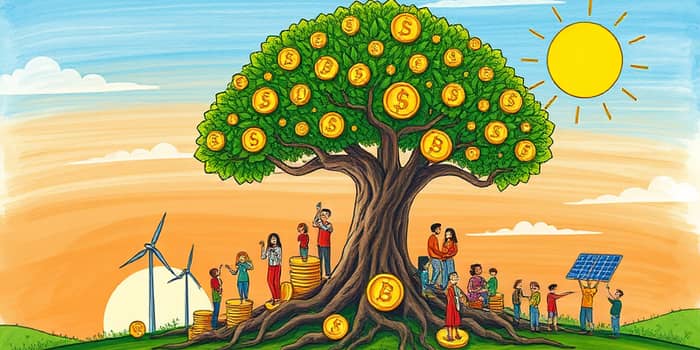
In a world facing mounting environmental and economic risks, the concept of Protected Prosperity offers a path to integrating sustainability into finance. By aligning policy, private capital, and innovation, we can forge a future where communities thrive as our planet heals.
This article explores the pillars of sustainable financial growth—policy leadership, private finance mobilization, technological innovation, and resilience. It provides actionable insights for governments, investors, and civil society to build a more secure and equitable global economy.
Effective policy frameworks are the backbone of long-term transition. The Baku to Belém Roadmap (B2B) unveiled at COP30 commits $1.3 trillion annually by 2035 to clean energy, adaptation, nature protection, just transitions, and loss and damage in emerging markets and developing countries.
Complementing this, the Coalition of Finance Ministers for Climate Action and the Network for Greening the Financial System (NGFS) emphasize the urgent need to address short-term climate risks to growth, stability, and inflation. Over 50 interoperable sustainable taxonomies post-COP30 ensure consistent definitions and reporting standards.
Private capital must scale rapidly to meet growing needs. Current projections call for a leap from $40 billion in climate finance in 2022 to $650 billion in private contributions by 2035, and $1.9 trillion in domestic funding.
Around 86% of asset owners across North America, Europe, and Asia Pacific plan to boost their sustainable allocations. Early 2026 relaunches of the Net-Zero Asset Managers initiative, combined with robust banking and insurance pledges, signal a deepening commitment.
Advances in technology and shifting demographics present rich investment prospects. From AI-driven climate risk analytics to inclusive agricultural practices, innovators are creating scalable solutions across sectors.
Decarbonization pathways, guided by the Net Zero Investment Framework and Paris-aligned ETFs, channel capital into renewable energy, green buildings, and low-carbon transport. In emerging markets like Vietnam, policy resolutions support renewable data centers and supply-chain decarbonization.
Embedding resilience into financial frameworks safeguards progress. Financial institutions must adopt mobilizing private sector capital toward nature action, deploying standardized metrics to measure biodiversity impact and ecosystem services.
Boards are elevating sustainability to core KPIs, balancing returns with social and environmental outcomes. By integrating advanced AI models, organizations can anticipate shocks, preserve cash runways, and retain customers through turbulent periods.
Building resilient, long-term economic expansion involves stress-testing portfolios against climate scenarios and ensuring transparent reporting that fosters stakeholder trust.
Transitioning from commitments to deployment demands robust governance and partnerships. Civil society organizations play a critical role in evidence-based climate risk modeling and in holding institutions accountable for progress.
Key challenges include headwinds such as cuts to public finance and regulatory pushback on ESG standards. Yet the record issuance of green bonds and clean energy investments in 2025 demonstrates momentum remains strong.
Standardizing nature metrics, enhancing cross-sector collaboration, and monitoring outcomes through transparent frameworks will turn ambitious pledges into measurable impact.
Protected Prosperity is not an idealistic dream—it is a strategic imperative. By aligning global policy leadership with private sector ingenuity, we can unlock trillions in sustainable capital and build an economy that thrives in harmony with the planet.
Stakeholders at every level have a role to play: policymakers must enact clear frameworks, investors must commit to long-term performance, and innovators must develop scalable solutions. Together, we can cultivate integrating sustainability into finance and secure a future of enduring prosperity and resilience.
References