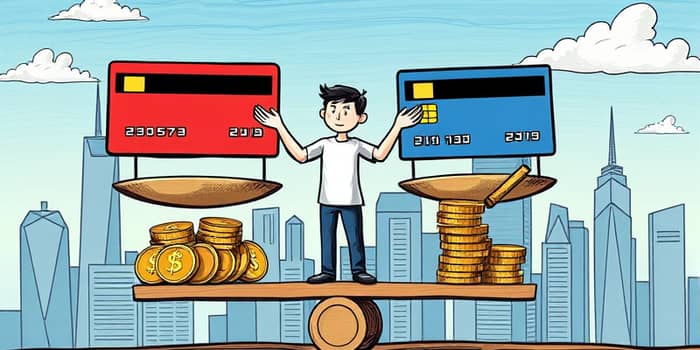
Credit cards can feel like a double-edged sword, offering unmatched convenience and rewards while carrying the risk of weighty debt. Understanding how they shape your spending is essential.
By mid-2025, U.S. credit card balances reached a historic high of $1.209 trillion, though growth has slowed in recent quarters. Consumers added $24 billion in Q3 2025 alone, driving total balances to $1.23 trillion by late 2025.
Despite this climb, debit card spending outpaced credit for the first time in four years, growing 6.57% versus 5.65% in H1 2025. This shift hints at more cautious behavior, even as average balances per cardholder rose to $7,886 by Q3 2025.
More than 61% of cardholders carried balances for at least a year, and 47% rolled month to month, while delinquency rates hovered at 2.57% for accounts 90+ days past due.
When used responsibly, credit cards can bolster your financial health.
With no annual fee and full monthly payments, you avoid interest entirely, reaping perks at zero cost.
Credit cards also carry hidden dangers that can erode your budget.
Inflated spending often occurs because credit delays the payment “pain,” leading to impulse buys and 12–18% more spending compared to cash.
High APRs—averaging over 24% in late 2025—mean daily interest accrues rapidly on unpaid balances, siphoning dollars meant for essentials.
Long-term debt traps are common: 31% carry debt for three years or more, and 21% for five years or longer, making recovery a slow, stressful process.
Several macro factors amplify the budgetary impact of credit cards:
• Rising interest rates—APR jumped from 16.3% in 2020 to over 24% by 2025—make borrowing costlier.
• Inflation pressures lead households to rely on cards for groceries, healthcare, and emergencies; 41% cite unexpected costs as the main debt cause.
• Demographic disparities leave Gen X and low-income consumers most vulnerable, holding higher debt than pre-pandemic peers.
Underwriting standards have stabilized, keeping delinquency flat, but economic headwinds could strain budgets further if incomes stagnate.
Looking ahead, credit card balances are forecast to rise modestly to $1.18 trillion by end of 2026, marking the slowest growth since 2013. Delinquency rates are expected to remain near current levels if employment and underwriting hold steady.
High-income households will likely continue driving spending resilience, while middle-class borrowers may feel the pinch of persistent inflation. Despite these challenges, responsible credit management can yield long-term financial resilience and improved credit health.
Ultimately, understanding both the promises and pitfalls of credit cards empowers you to harness their advantages while safeguarding your budget. Armed with data, discipline, and the right strategies, you can transform plastic from a potential liability into a powerful financial ally.
References