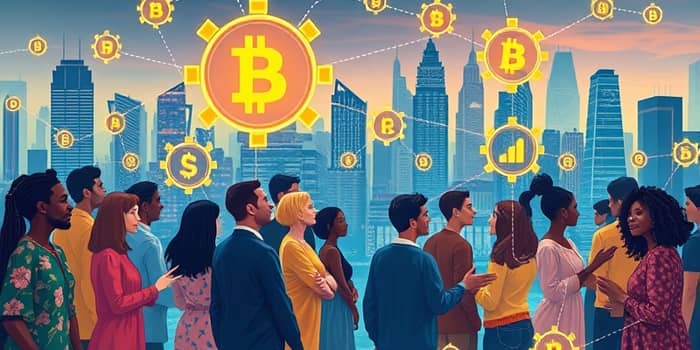
In an era where financial inclusion and transparency are paramount, Decentralized Finance (DeFi) offers a revolutionary alternative to traditional banking systems. By harnessing blockchain technology and smart contracts, DeFi empowers individuals across the globe to access financial services with unprecedented freedom and control.
This article delves deep into the transformative potential of DeFi, explores its core offerings, weighs its benefits against its risks, and charts a course for the future of finance.
At its heart, DeFi is a blockchain-based financial ecosystem that eliminates intermediaries like banks. Instead of relying on centralized institutions, it uses automated smart contracts deployed on public networks such as Ethereum. These contracts execute financial operations—lending, borrowing, trading—when preset conditions are met.
Anyone with an internet connection and a crypto wallet gains permissionless access to peer-to-peer services, bypassing lengthy KYC procedures and geographical restrictions. Transactions are recorded on public ledgers, ensuring full transparency and immutability of records.
DeFi replicates and often enhances traditional financial offerings through decentralized applications (dApps). Key services include:
These services operate around the clock, offering borderless financial access and often delivering higher yields than traditional savings accounts.
While traditional finance (TradFi) depends on hierarchical institutions and physical infrastructures, DeFi’s decentralized architecture confers several key advantages:
Despite its promise, DeFi carries inherent risks. Users remain responsible for their private keys; a lost key means lost funds. Smart contract vulnerabilities have led to high-profile exploits, and lack of regulation can expose participants to fraud and market manipulation.
A balanced perspective acknowledges both the strengths and limitations, guiding responsible adoption and ongoing improvement.
As DeFi matures, several trends are poised to shape its trajectory and bridge gaps with TradFi:
Moreover, layer-two scaling solutions and next-generation smart contract platforms aim to tackle throughput constraints, making DeFi more robust and accessible.
To fully harness DeFi’s potential, users should cultivate a strong understanding of protocol mechanics, adopt rigorous security practices, and maintain diversified strategies. Community-driven audits, educational initiatives, and collaborative governance models will further strengthen the ecosystem.
By combining cutting-edge technology with prudent risk management, DeFi can redefine financial systems, making them more equitable, transparent, and resilient.
In conclusion, DeFi stands at the crossroads of innovation and responsibility. Its capacity to democratize finance is unparalleled, but success hinges on careful stewardship, technological refinement, and constructive collaboration with regulators and institutions.
Embracing DeFi today means participating in a financial revolution—one that empowers every individual to become an active architect of their own economic destiny.
References